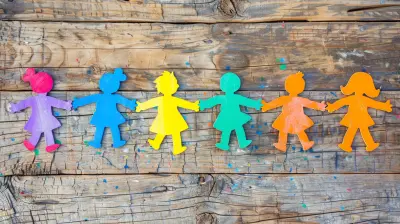
How to Create Boundaries That Grow as Your Child Grows
24 February 2026
As parents, we walk a fine line between guiding our children and giving them the freedom to explore. Setting boundaries is essential, but those boundaries shouldn't be rigid. Just like kids outgrow their clothes, they also outgrow certain rules and limits. So, how do you create boundaries that evolve as your child grows? Let’s break it down.

Why Boundaries Matter
Boundaries give kids a sense of security. They help children understand expectations, develop self-discipline, and build respect for others. Without boundaries, life can feel chaotic, and kids might struggle with self-control.But here’s the challenge—boundaries aren't one-size-fits-all. What works for your toddler won’t work for your teenager. That’s why boundaries should grow and change as your child matures. 
Setting Boundaries for Toddlers (Ages 1-3)
Toddlers are naturally curious. They test limits because they’re learning how the world works. At this stage, boundaries should focus on safety and basic routines.What Boundaries Look Like for Toddlers
✔ Simple, clear rules – "We don’t hit." "Food stays on the table."✔ Consistency is key – Repeating the same rules helps toddlers understand them.
✔ Immediate consequences – If they throw a toy, they lose it for a while.
✔ Safety first – "Hold my hand when we cross the street."
✔ Allow choices – "Do you want the red cup or the blue one?" This gives toddlers a sense of control while still keeping limits in place.
How to Enforce Boundaries at This Stage
- Use gentle but firm communication—get down to their level and use a calm tone.- Redirect when needed—if they’re throwing blocks, show them how to stack them instead.
- Be patient—toddlers are still developing impulse control.

Adjusting Boundaries for Preschoolers (Ages 4-6)
Preschoolers start to understand rules better but still push limits. They also crave independence. Now’s the time to introduce flexible boundaries.What Boundaries Look Like for Preschoolers
✔ More detailed explanations – "We hold hands in the parking lot to stay safe because cars can't always see little kids."✔ Encourage responsibility – "You need to put your toys away before bedtime."
✔ Logical consequences – If they refuse to wear a coat, they might feel cold (natural consequence).
✔ More choices within limits – Instead of saying “No snacks,” say, "Would you like an apple or yogurt?"
How to Enforce Boundaries at This Stage
- Use positive reinforcement—praise good behavior instead of just punishing bad behavior.- Stick to routines to make boundaries feel predictable.
- Give age-appropriate freedoms—like letting them pick their clothes, even if they end up mismatched!

Adapting Boundaries for School-Age Kids (Ages 7-12)
Now, kids are more independent and capable of understanding complex rules. They also start questioning why rules exist.What Boundaries Look Like for School-Age Kids
✔ Explain the "why" behind rules – "Screen time is limited because too much can affect your sleep."✔ Encourage problem-solving – "What do you think is a fair way to split playtime with your sibling?"
✔ Expand responsibilities – Chores, time management, and schoolwork should become part of their routine.
✔ Set digital boundaries – Establish rules for screen time and online safety.
How to Enforce Boundaries at This Stage
- Use logical consequences—if they don’t do homework, they deal with the teacher’s reaction.- Encourage open discussions—let them have a say in the rules when appropriate.
- Start teaching self-regulation—help them understand emotions and manage frustration.
Evolving Boundaries for Teenagers (Ages 13-18)
Ah, the teenage years—where kids want freedom but still need guidance. This is when boundaries should focus more on trust, responsibility, and preparing them for adulthood.What Boundaries Look Like for Teenagers
✔ More negotiation – Rather than enforcing rules, involve teens in setting limits.✔ Independence within reason – Later curfews, unsupervised outings, but with mutual trust.
✔ Online safety & privacy – Discuss social media, privacy, and responsible internet use.
✔ Respect personal space – Teenagers need autonomy but still require accountability.
How to Enforce Boundaries at This Stage
- Mutual respect is key—listen to their point of view, even if you don’t agree.- Trust but verify—give them room to prove responsibility, but keep communication open.
- Use natural consequences—if they stay up late, they’re tired the next day. Let them learn from experience.
Common Pitfalls to Avoid
✅ Inconsistency – If rules change daily, kids get confused. Try to be steady.✅ Being too rigid – Boundaries should evolve, not be set in stone.
✅ Fear of saying no – Kids need limits, even if they don’t like them.
✅ Ignoring their growing independence – Give them space to make choices and mistakes.
Remember, boundaries are less about control and more about guidance. They should support your child’s development, not restrict it.
Final Thoughts
Creating boundaries that grow with your child isn’t always easy, but it’s necessary. Think of it like a tree—you provide the roots (structure and values), but as your child grows, you also need to allow their branches to stretch toward independence.The key is balance—give them the freedom to explore while ensuring they have the safety net they need. And most importantly, stay adaptable. Because just when you think you’ve figured it all out, they’re onto the next stage!
all images in this post were generated using AI tools
Category:
Parenting BoundariesAuthor:

Noah Sawyer
Discussion
rate this article
2 comments
Ruby Willis
Creating evolving boundaries fosters a child's independence and responsibility. As they grow, adapt your approach, nurturing their autonomy while providing the support they need to thrive.
March 2, 2026 at 4:47 PM
Noah Sawyer
Thank you for your insightful comment! Evolving boundaries are indeed essential for fostering independence while ensuring children feel supported. Balancing autonomy and guidance is key to their growth.
Alanna McCaw
How do boundaries evolve with different ages?
March 1, 2026 at 4:49 AM
Noah Sawyer
Boundaries evolve as children mature, shifting from strict rules for safety to collaborative discussions that promote independence and responsibility, adapting to their developmental needs and understanding.